The Invisible Hand: Adam Smith's Famous Idea
What Smith actually said
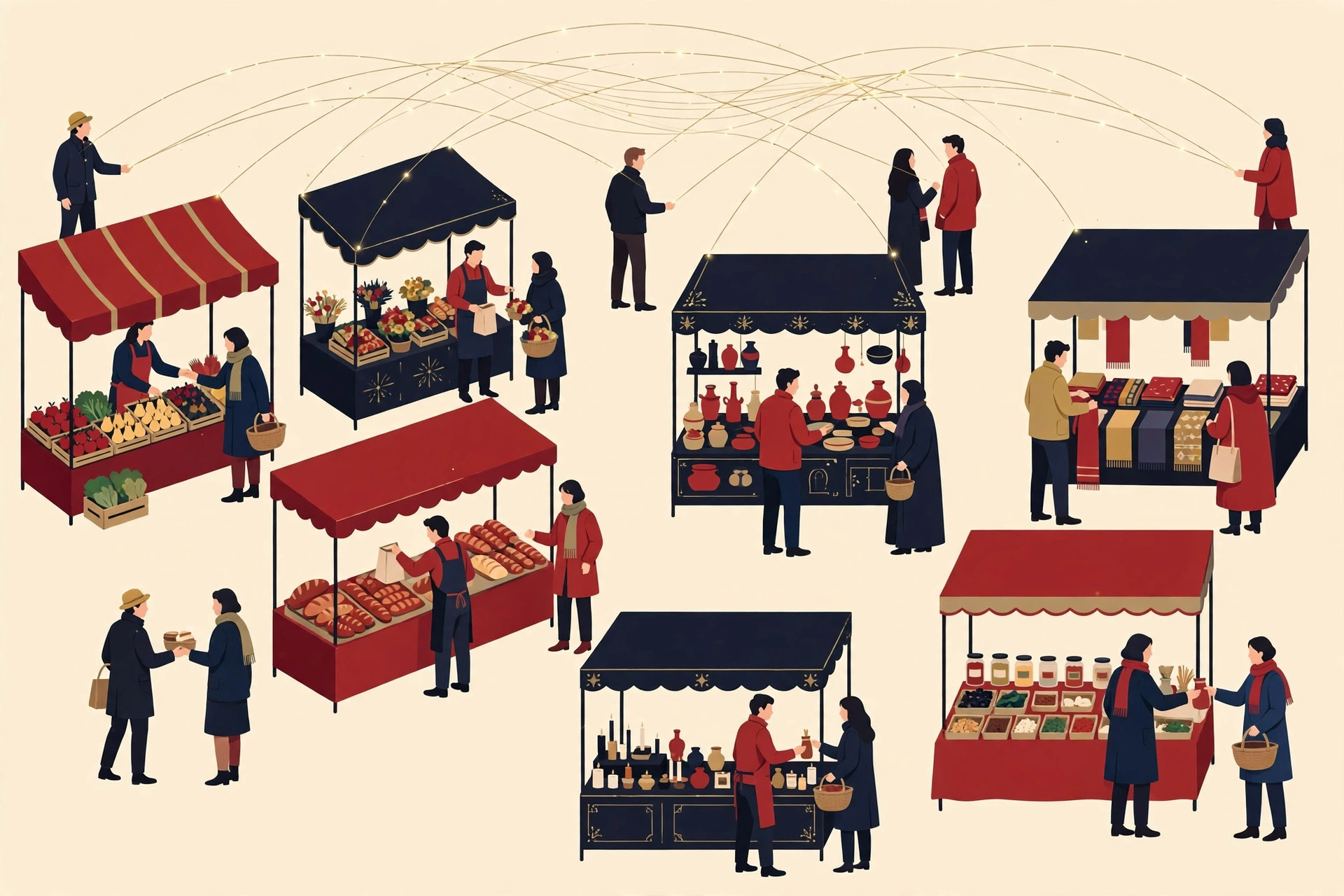
The phrase appears once in The Wealth of Nations, in a specific argument: a merchant who prefers to invest at home for safety, rather than chase higher returns abroad, is led by an invisible hand to promote an end which was no part of his intention, namely the prosperity of his own society. Smith used the image sparingly across all his work, and never as a blanket promise that self-interest always serves the public. The modern idea attached to his name is broader and more rigorous: in competitive markets, prices carry information and incentives that coordinate millions of strangers, each pursuing their own ends, into patterns nobody designed, bakers baking not from benevolence but from self-love, as Smith put it in his most quoted sentence on the subject. The hand is not magic; it is the price system, and its working parts are the supply and demand machinery in the earlier guides on this site.
When the hand works, and the conditions it needs
Twentieth-century economics formalised the claim into theorems with explicit conditions: competition with many buyers and sellers, no externalities, no public goods, information good enough for choices to mean something. Where those conditions roughly hold, markets are astonishing coordinators: no ministry could organise the daily feeding of a city by instruction, yet prices, profits and losses do it continuously, rerouting around droughts and strikes without a meeting being called. The theorems also mark the boundary with unusual honesty, because each failed condition names a chapter of this guide series: monopoly where competition fails, externalities where costs escape prices, public goods where prices cannot attach, and the information problems that behavioural and institutional economics study. The invisible hand, read properly, is not an argument that markets always work. It is a map of exactly when they do, drawn by the people who proved it.
The metaphor's career and its critics
Few ideas have been asked to carry more political weight. Admirers quote the hand to end arguments it was never meant to settle; critics attack the slogan as if refuting it refuted price theory. Both miss the working content. The serious inheritance is a research programme: for any market outcome, ask which condition is doing the work, or failing. Is this price high because of scarcity, which is information, or because of market power, which is a problem? Is this shortage a signal to produce more, or a symptom of a price control forbidding the signal? Smith himself, who wrote as fiercely about merchants conspiring against the public as about the hand that guides them, would have recognised the questions as his own. The metaphor survives not because it flatters any ideology but because, three centuries of testing later, the coordination it describes remains the single most impressive phenomenon in social science.
Run the numbers yourself
The free calculator that goes with this guide:
Measure what the hand creates