Public Goods: What Markets Struggle to Provide
Two tests that markets fail
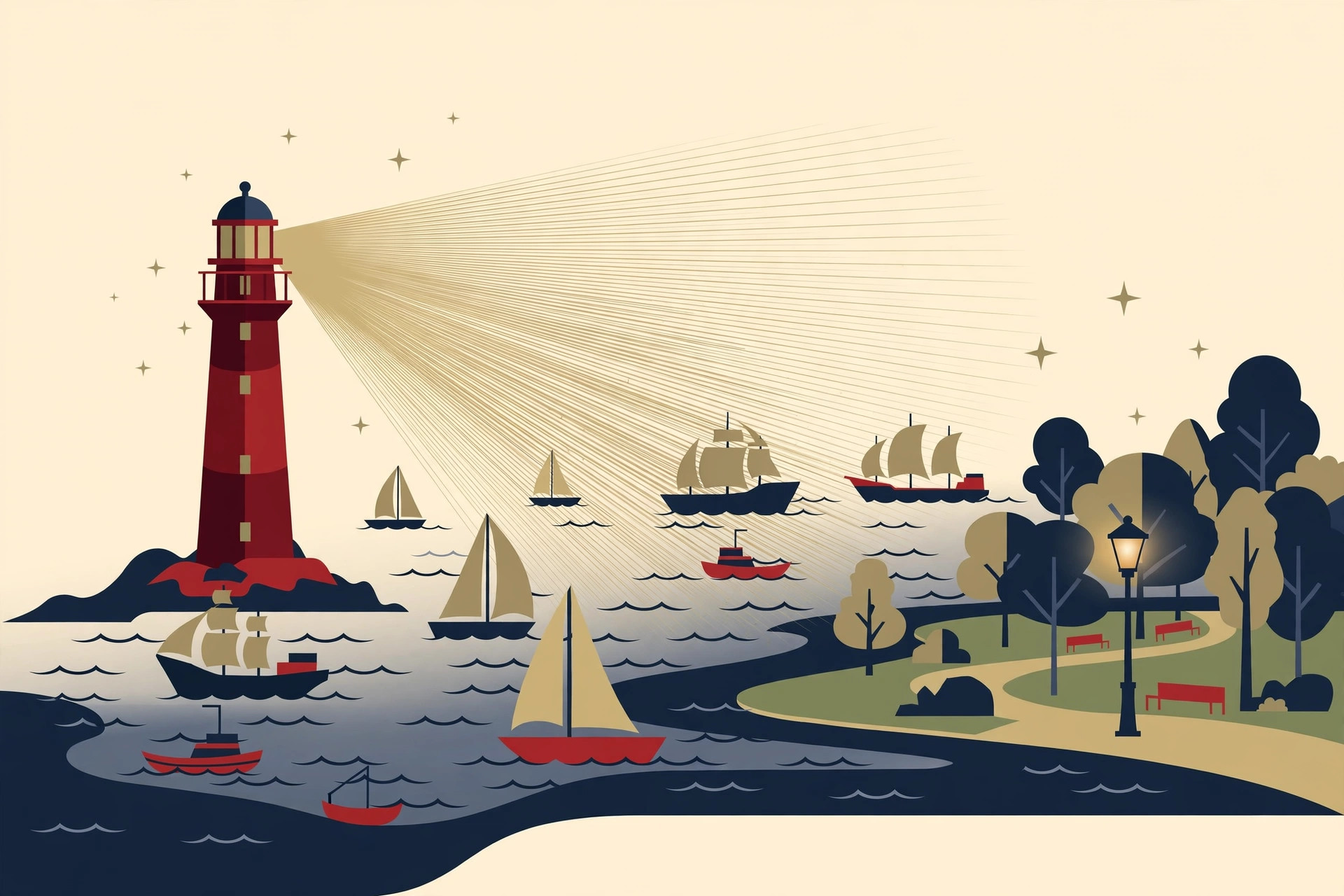
A public good passes two tests that break the market mechanism. It is non-excludable: once provided, nobody can be stopped from enjoying it, so nobody can be charged. And it is non-rival: one person's enjoyment does not reduce another's, so the marginal cost of an extra user is zero. The lighthouse is the classic case: every ship benefits whether or not it paid, and the beam is undimmed by being seen. National defence, flood barriers, street lighting and basic research share the structure. The problem is the free rider: each person reasons that their own contribution is a drop, enjoys the good if others fund it, and withholds payment, so the good is underprovided or not provided at all, however much everyone values it in total. Markets do not fail here because people are selfish; they fail because the price signal itself cannot be attached.
How societies respond
The standard answer is collective provision: tax everyone, supply the good free at the point of use, and argue democratically about the quantity. That solves the free rider by compulsion, and replaces the market's missing signal with a political one, with all the imperfections of cost-benefit arguments conducted by slogan. Between pure market and pure state lies a spectrum of hybrids. Some goods are excludable after all with technology: encrypted broadcasts and toll roads convert public goods into club goods that markets can sell. Some are provided by charity and open collaboration: Wikipedia and open-source software are public goods funded by donations and volunteered time, proof that free riding is a tendency, not a destiny. And some goods that look public are merely congestible, like parks and roads at rush hour, where the rivalry returns with crowding and pricing can work again. Sorting a claimed public good into the right box is the first analytic step, because each box has a different best owner.
Why the concept earns its keep
Public goods reasoning protects against two opposite errors. The first is expecting markets to supply what they structurally cannot, then blaming greed when lighthouses go unbuilt. The second is labelling anything popular a public good to claim public money: most goods are rival and excludable, and calling them public does not make them so. Climate stability is the largest genuine case on the current agenda, a global public good whose free rider problem plays out between nations rather than neighbours, which is why climate negotiations crawl at the speed of the least willing. The framework also clarifies the state's core economic job description, the one even minimal-state economists concede: provide what cannot be priced, police what can, and tax as cleanly as possible to fund the difference. Every budget line can be audited against that sentence, and most arguments about the size of government are, underneath, arguments about where the boundary of the unpriceable truly lies.