Okun's Law: The Link Between Jobs and Growth
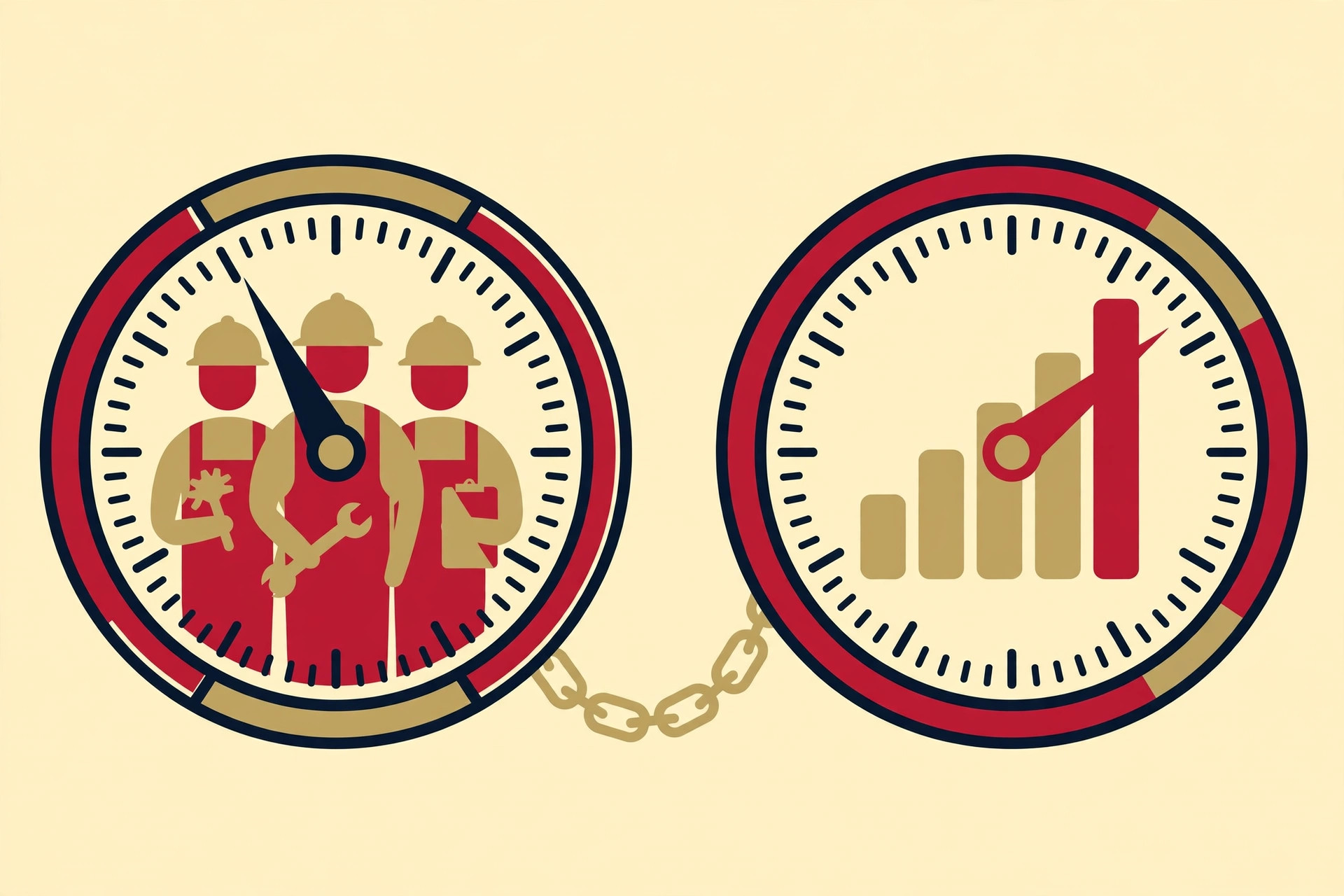
A relationship found in the data
In the early 1960s the economist Arthur Okun noticed a sturdy pattern in American figures: when unemployment rose one percentage point above its natural level, real GDP sat roughly two to three percent below its potential. When unemployment fell back, output recovered by a similar multiple. The relationship became Okun's law, and the calculator on this site applies it in its standard form: output gap equals minus the coefficient times the change in unemployment. It survives because it captures something real about how firms behave. Employers hoard labour through small downturns, cut hours before heads, and squeeze more from existing staff in upturns, so output moves further than employment in both directions. Jobs are the lagging shadow; output is the object casting it.
How policymakers actually use it
Okun's law is a translator between two languages governments care about: growth and jobs. A finance ministry forecasting two percent of lost output can estimate the unemployment cost; a central bank watching unemployment tick up can infer how much slack is opening in the economy, which feeds straight into judgements about inflation pressure. It also works as a lie detector for over-optimistic forecasts: a budget that promises rapidly falling unemployment alongside weak growth is quietly assuming the relationship has been repealed. The coefficient is not universal. It is nearer two for the United States, lower in countries where jobs are protected and hours adjust instead, higher where hiring and firing is easy. Any serious use starts by asking which country's coefficient belongs in the box.
How far to trust a rule of thumb
Okun himself presented the relationship as an empirical regularity, not a law of nature, and it has wobbled: jobless recoveries, the pandemic's violent swings, and shifts toward service and gig work have all bent it at times. Productivity changes can break it for a year or two, because output can grow through efficiency while headcount stands still. Treat the output of the calculator here as a first estimate, a way to size a recession's jobs cost or a boom's jobs dividend before the detailed models arrive. Its real value is disciplinary: it forces any story about growth to state its consequence for people's work, and any story about jobs to state its consequence for output. Sixty years after it was written down, that discipline is why the rule still earns its page in every macroeconomics course.
Run the numbers yourself
The free calculator that goes with this guide:
Estimate an output gap with Okun's law