The Keynesian Multiplier: How Spending Ripples
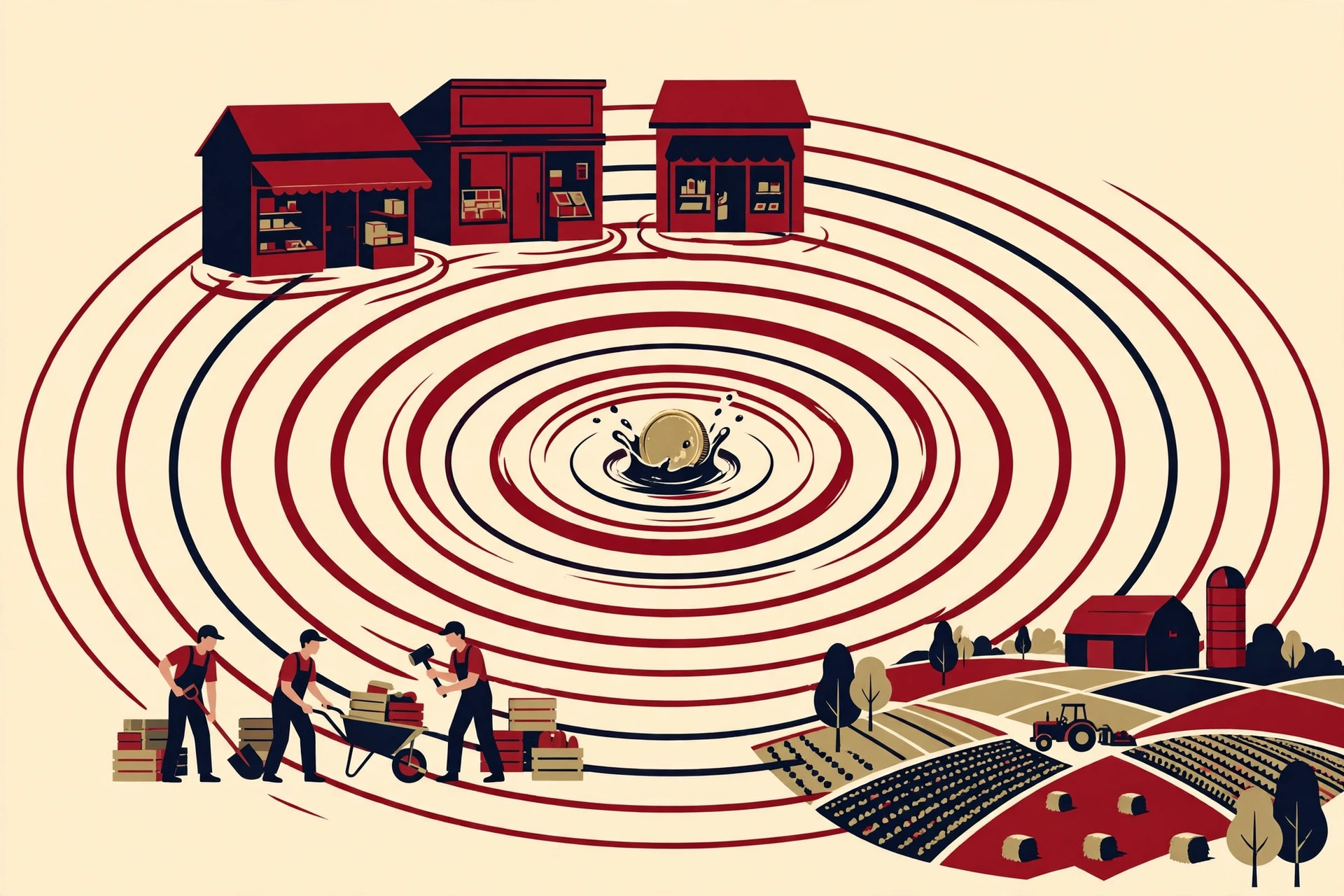
Spending is someone else's income
The multiplier begins with a circle: one person's spending is another person's income. If the government pays a builder 100 to repair a school, the builder now has 100 of extra income. If builders spend eighty percent of extra income, 80 flows to shops and suppliers, whose owners then spend 64, and so on in shrinking rounds: 100, 80, 64, 51, until the total added income approaches 500. The marginal propensity to consume, the share of extra income that gets spent, sets the size of the ripple. The multiplier is one over one minus that share, so an MPC of 0.8 gives a multiplier of five, exactly as this site's calculator computes. The idea, formalised by Keynes's circle in the 1930s, turned government spending from a cost into an engine.
Leaks: saving, taxes and imports
Each round of the ripple leaks in three places. Some income is saved. Some is taken in tax. Some is spent on imports, sending the demand abroad. The leakages decide how far below the textbook number real multipliers fall, and they differ by policy: spending aimed at low-income households, who spend nearly everything locally, multiplies harder than tax cuts for the wealthy, much of which is saved. In small open economies, imports drain the ripple fast, one reason tiny countries get less from stimulus than continental ones. The tax multiplier is also smaller and negative in sign: a tax rise of 100 with an MPC of 0.8 ultimately lowers income by about 400, not 500, because the first round of the contraction is only the 80 that would have been spent. Asymmetry like this is why the composition of a budget matters as much as its size.
Why economists still argue about it
Estimates of real multipliers range from below one to above two, and the argument is not noise: the multiplier depends on the moment. With idle workers and factories, extra demand calls forth real output; near full capacity, it mostly bids up prices and interest rates, and the central bank may deliberately offset it. At the zero lower bound on interest rates, with monetary policy unable to lean back, multipliers are thought to be at their largest, which is why stimulus in deep slumps has heavyweight defenders. The mature view treats the multiplier not as a constant of nature but as a weather report: read the economy's slack first, then decide how hard a fiscal push will land. The calculator gives the clean textbook figure; this guide is the warning label that belongs on it.