How Interest Rates Work and Why They Move
The price of time
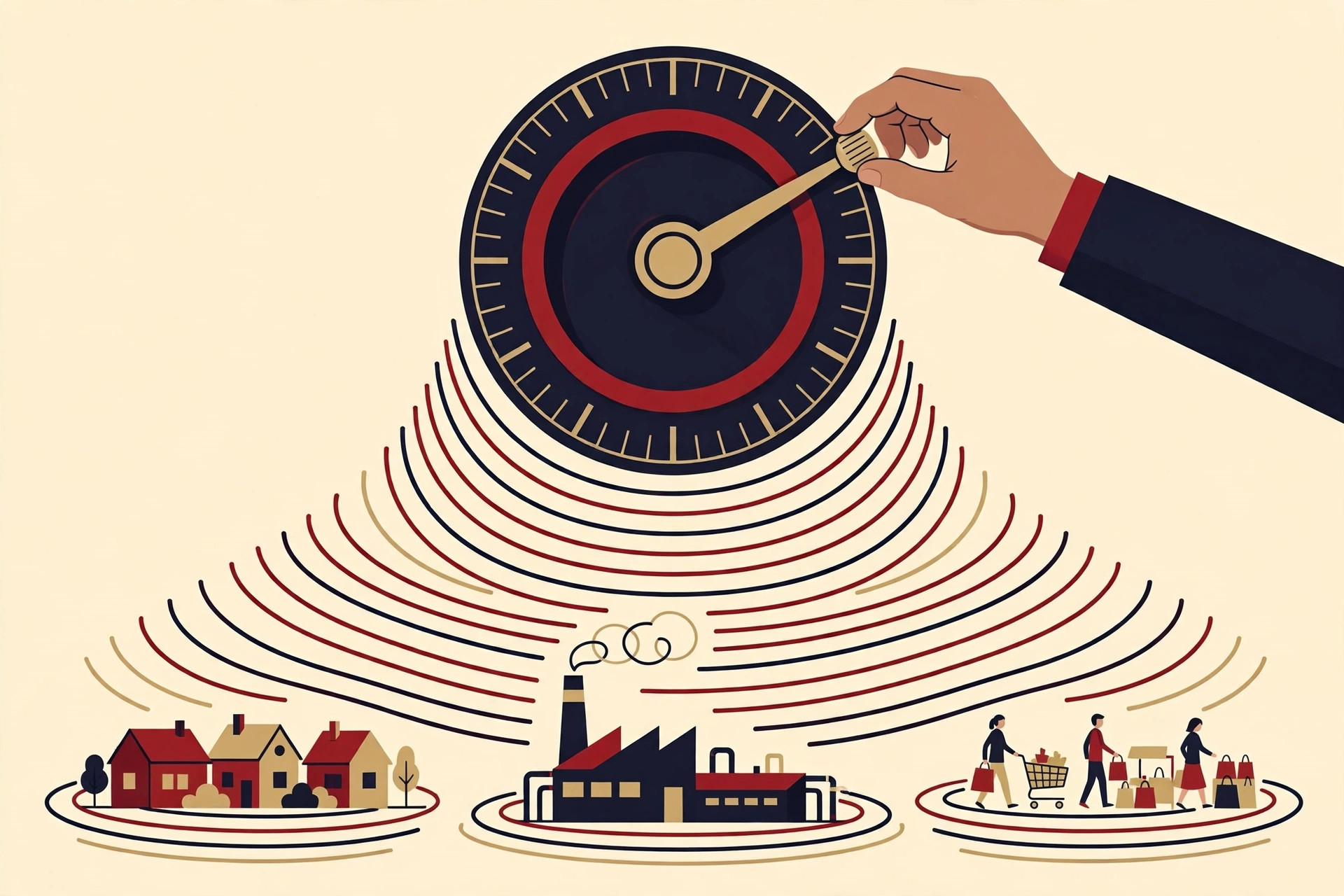
An interest rate is the price of moving money through time: what a borrower pays to have money now, and what a lender earns for waiting. Like any price, it balances supply and demand, the supply of savings against the demand for loans, but it is also steered deliberately by central banks, which makes it the most managed price in the economy. Rates are quoted per year and come in layers. At the bottom sits the central bank's policy rate. Above it stack the rates banks charge each other, then mortgages, business loans and credit cards, each adding a margin for risk, cost and profit. When the policy rate moves, the whole stack shifts, though not instantly and not by identical amounts, like a column of springs settling after a push.
How a rate change travels
Raise the policy rate and the effects ripple outward along predictable paths. Borrowing for houses and investment gets dearer, so demand for both cools. Saving pays better, nudging households to postpone spending. The currency often strengthens as foreign money chases higher returns, making imports cheaper and exports harder to sell. Asset prices, from houses to shares, tend to sag because future earnings are discounted more heavily. All of this leans against spending, and with a lag of a year or more, against inflation. Cut rates and every channel runs in reverse. Economists call this the transmission mechanism, and its long, variable lags are why central bankers must act on forecasts rather than on the inflation they can already see, steering a ship that answers the wheel slowly.
Nominal, real, and the rate you actually face
The rate on a poster is nominal. The rate that decides behaviour is real: nominal minus inflation, exactly as the Fisher equation in this site's calculator sets out. Savers earning less than inflation are losing buying power at a negative real rate, however positive the poster looks. Borrowers in the same position are being subsidised. Risk writes the rest of the story: the gap between a government bond rate and a small firm's loan rate is the market pricing the chance of not being repaid, and in crises that gap can explode even while policy rates sit at zero, which is why cheap central bank money does not always reach the businesses that need it. Reading any interest rate well means asking three questions: nominal or real, for whom, and against what alternative.
Run the numbers yourself
The free calculator that goes with this guide:
Turn a nominal rate into a real one