How Banks Create Money From Deposits
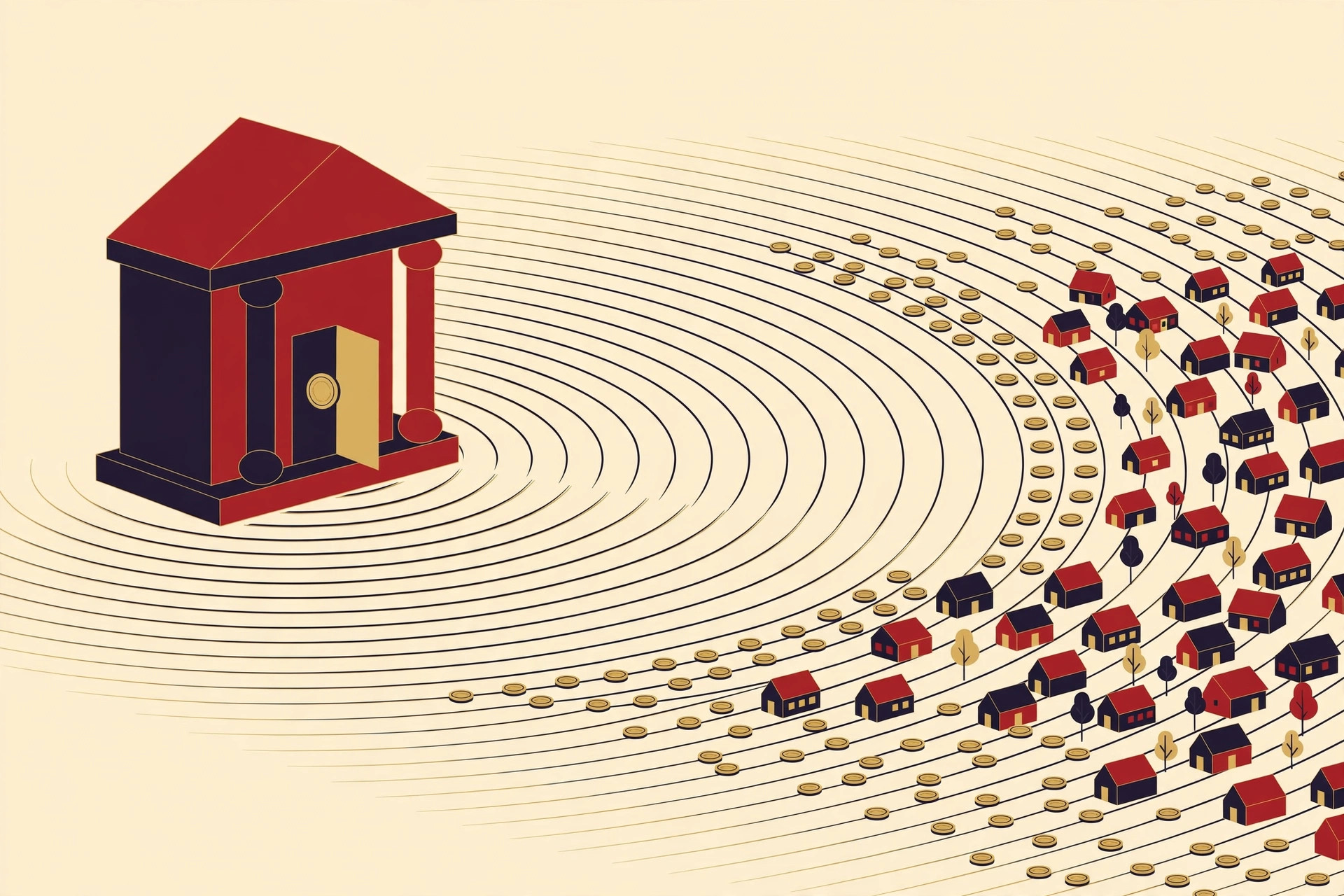
Where money actually comes from
Ask where money comes from and most people picture a printing press. In a modern economy the press is a sideshow: the great majority of money is bank deposits, created when commercial banks make loans. When a bank approves a mortgage, it does not wheel out a trolley of saved cash; it types new deposit money into the borrower's account, and the money supply grows by that amount. When the loan is repaid, that deposit money disappears again. This is not a conspiracy theory but the description central banks themselves publish. The textbook money multiplier frames the limits of the process: banks must hold reserves against deposits, and if the reserve ratio is ten percent, each unit of reserves can support up to ten units of deposits across the banking system as a whole.
The multiplier, round by round
Follow one deposit of 1,000 with a ten percent reserve ratio. The first bank keeps 100 and lends 900. That 900 is spent and lands in a second bank, which keeps 90 and lends 810. Round by round the new lending shrinks by a tenth each time, and the infinite sum settles at 10,000 of total deposits supported by the original 1,000 of reserves: the multiplier is one over the reserve ratio, as this site's calculator shows. Two leakages shrink the real-world figure: people holding cash instead of depositing it, and banks choosing to hold extra reserves for safety. After 2008, banks sat on mountains of extra reserves and the textbook multiplier collapsed, which is why vast central bank balance sheets did not produce the inflation simple multiplier logic predicted. The formula is a ceiling and a teaching device, not a forecast.
Why this matters beyond the classroom
Money creation by lending explains features of economies that printing-press thinking cannot. Credit booms create money and spending power together, which is why property bubbles feel like prosperity while they inflate. Credit crunches destroy money as loans are repaid or written off, deepening recessions in a way governments must counteract. It also explains why regulating banks is regulating the money supply itself, and why a bank run is so dangerous: deposits are money, and their disappearance is a monetary contraction, not just a banking problem. None of this means banks create money without limit. Capital rules, creditworthy borrowers, interest rates and their own fear all bind. But the direction of causation, loans creating deposits, is the single most clarifying idea in monetary economics, and the multiplier is its arithmetic skeleton.
Run the numbers yourself
The free calculator that goes with this guide:
Calculate the money multiplier